
Cytotoxicity Assays
Assess single chemicals or entire compound libraries for potential toxicity and gain mechanistic insights to de-risk your research and development.
Common Assays We Offer
Cytotoxicity Assays
Determining cytotoxicity, or harm to cells, is a critical component of identifying the viability of new chemical entities (NCEs) and other compounds early in the pre-clinical phase of drug development or product discovery. Cytotoxicity assays measure cell viability, offering researchers key insight into potential adverse effects and can greatly improve the success of new compounds in animal safety studies, human clinical trials, and Next Generation Risk Assessments (NGRAs).
We offer carefully designed in vitro cytotoxicity tests and screening models that are mechanism-based. As a result, we can provide information on the relative toxicity of individual NCEs – with higher-throughput options to assess full compound libraries. We offer specialized expertise in small molecules, nanoparticles, antibody drug conjugates (ADCs), oligonucleotides, and antisense oligonucleotides (ASOs). We can work with your team to monitor changes in toxicity as you optimize the candidate molecules.
Why partner with LifeNet Health® Life Sciences for your mechanistic toxicity studies?
Our experienced team is committed to helping you identify and customize endocrine disruption assays that accurately assess your drug candidate using methods based on current regulatory guidelines.
Our expansive services portfolio includes standardized methods as well as advanced methodologies only available to our partners. Our ability to utilize directly sourced, high-quality tissues, cells, and cell models sets us apart, enabling assay results that more accurately reflect human biology.
Our assay services team is committed to providing high quality data with timely turnaround for research and regulatory submission requirements.



Expert regulatory
guidance

Capture toxicity, inflammatory, and fibrogenic responses using TruVivo®
TruVivo is an easy-to-use, in vitro 2D+ hepatic system that mimics the microarchitecture and basic functionality of the human liver. This system is comprised of a mixture of primary human hepatocytes, endothelial cells, and stromal cells that self-assemble to form multicellular colonies along with a mixed feeder cell population. TruVivo’s extended viability, architectural integrity, physiologically relevant albumin and urea production, and stable transporter and metabolic capacity enhance relevance and reliability for assessing toxicity, inflammation, and fibrogenesis following chemical exposure.
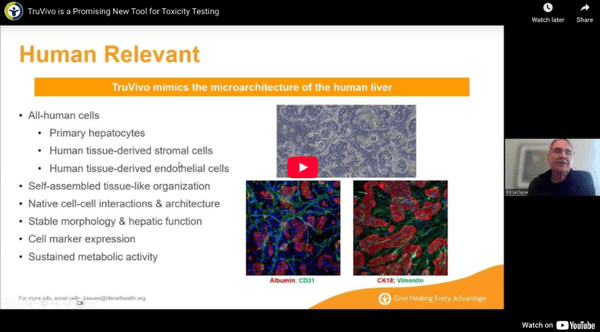
- How CYP and UGT enzymatic activity and transporter uptake in TruVivo remains functional and stable for greater than 14 days.
- How TruVivo accurately ranks the toxicity of several reference compounds representing multiple mechanisms of action.
- How the addition of human Kupffer cells in the TruVivo system successfully captures inflammatory and fibrogenic responses that lead to enhanced compound toxicity.