Multi-Organ Microphysiological System (MPS)
Simultaneously capture superior, human-relevant data on a compound’s systemic impacts across multiple 2D and 3D tissues and cells.
Enhancing biological relevance and reducing reliance on animal testing with an advanced in vitro model
Organ-on-a-chip and micro-scale MPS platforms provide limited compound testing data due to the use of small tissue masses and low fluid volumes, making it difficult for product developers to make informed decisions. Our novel integrated multi-organ MPS offers greater physiological accuracy, simplicity, and affordability than organ-on-a-chip and micro-scale systems.
The LifeNet Health MPS model is highly versatile.
It can accommodate nearly any cell or tissue model. Each organ compartment is isolated with no net fluid exchange between organ members, meaning that each organ cell model can be cultured under optimal conditions. The simulated vasculature utilizes semi-permeable membranes that allow the test compound and metabolites to move in and out, and flow rates can be adjusted as needed. Transwell cell culture can be used to measure compound kinetics, metabolism, and toxicity in the same run. Key parameters like plasma protein binding, intestinal absorption, intrinsic clearance and metabolism can also be calculated.
Benefits
- Flexibility with multiple configurations for 2 to 4 organ study designs
- Allows for the simultaneous collection of pharmacokinetic data on metabolite formation and organ toxicity
- Time point sampling up to two weeks
- Assay Services lab able to perform both non-GLP and GLP studies
MPS organ combinations
Intestine-liver
Intestine-kidney
Intestine-liver-kidney
Intestine-liver-thyroid
Skin-liver
Skin-kidney
Skin-liver-kidney
Lung-liver
Lung-kidney
Lung-liver-kidney
How it works
Our multi-organ MPS system is compatible with most commercially available tissue models, including our own TruVivo 2D+ Hepatic System and a fully functional 3D thyroid microtissue model. This flexible platform can meet various experimental design needs, enabling the choice of multiple organ combinations and simulated exposure routes to obtain biologically relevant data. Our team works with you to customize study designs, data analysis, and reporting to ensure compatibility with your research goals.
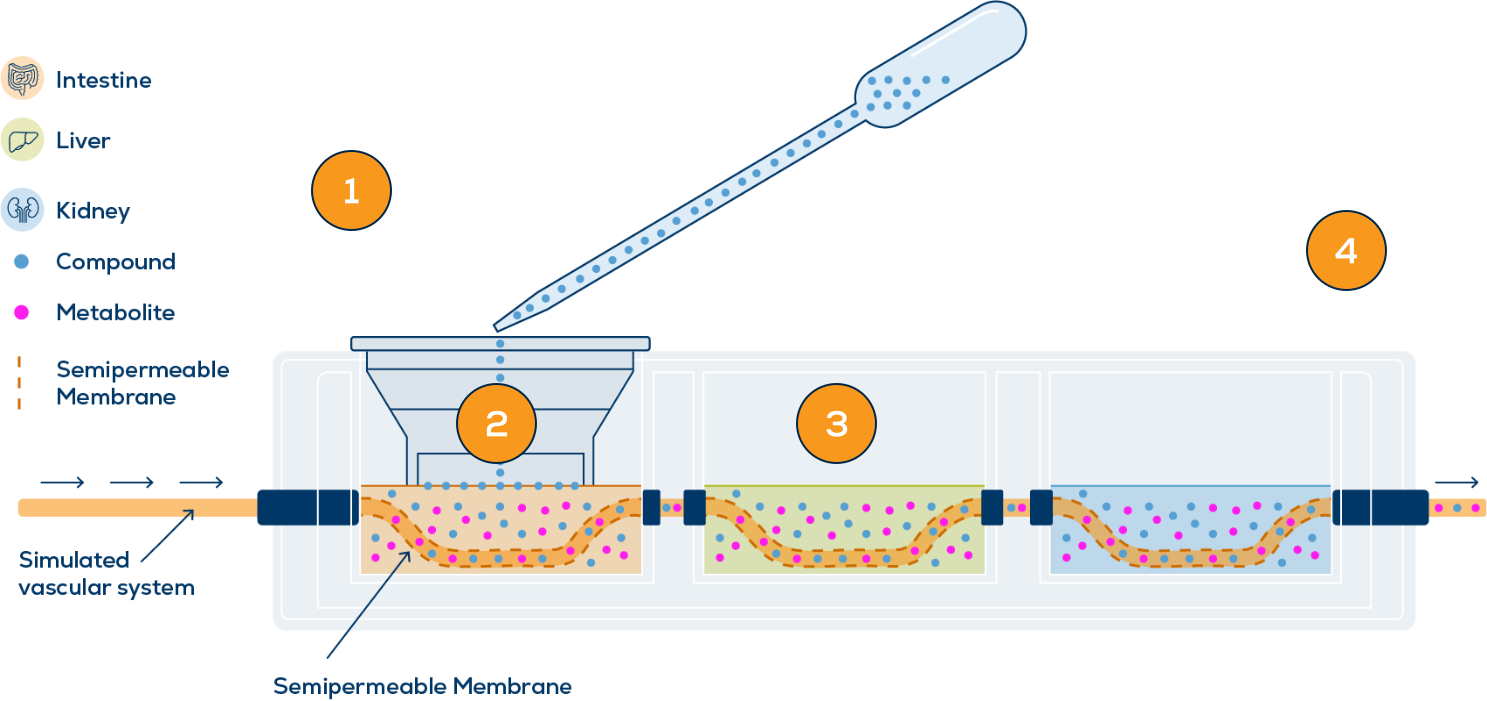
Our MPS can simulate various exposure routes
- IV injection
- Dermal
- Oral
- Inhalation
Find answers to our most frequently asked questions below
Our MPS system allows for up to four isolated organs, each in their own optimal media, connected only by a simulated blood flow. This mimics in vivo physiology, allowing for more physiologically relevant dilution and distribution of parent molecules and metabolites.
In collaboration with the US FDA/SFSAN, we presented at SOT 2024 findings that our integrated organ MPS platform produced kinetic curves for usnic acid (UA) that were dose dependent. At relevant in vitro doses, UA had significant cytotoxic effects in the liver. The primary mechanism for cytotoxicity was mitochondrial disruption. These findings are consistent with those reported in the literature. This MPS platform is applicable to rapid response testing and hazard identification.
Combinations of 2, 3, and 4 organs using most commercially available cell or tissue models can be accommodated. Common combinations include: Intestine+Liver+Kidney; Intestine+Liver+Thyroid; Lung+Liver+Kidney; Skin+Liver+Kidney ?
Yes, in a presentation at SOT 2024 we described a study that provided dose dependent kinetic, metabolism, and toxicity data that was consistent with published literature for both test compounds. These data will assist in the development of mathematical models designed to extrapolate the in vitro information to in vivo exposure and hazard identification. This type of MPS platform is versatile and can be used with many cell and tissue models already validated. The system allows collection of parent compound and metabolite kinetic data and provides the basis for NGRA and IVIVE models.
Yes, please see a paper published in Applied In Vitro Toxicology titled Developing Kinetic and Organ Toxicity Data with a Novel In Vitro Human-Based Multiple Organ MPS: Acrylamide as a Case Study.
Resources
Leveraging a Human-Based Microphysiological System for In Vitro Pharmacokinetic Assessment of Oral Drug Formulations

Harnessing A Three-Organ MPS Model to Assess Drug and Chemical Safety